
Why the Obsession with "Winning" Has Become Our Greatest Tragedy

Article by Rik Raats
—the fool who practices the pen in an attempt to process observations.
We've landed in the era of the absurd idea of winning and losing as good vs. bad. The reality is, more often than not, the loss of victory in the win and the blessing found in the disappointment, as Whistler's Mother taught us. Her icon is engraved in our American DNA; but her lesson seems forgotten.
So, let's visit the self-repairing virtue of the fool who lives in us. Let's take a moment, maybe to visit Jim Carrey's 'Behind Every Great Man Stands a Rolling Wife'.
Let's perhaps start the laughter that reveals the reality in the jester's joke—at least to learn more about the self-destructing world of so-called winners and losers.
Never before were we bestowed with such advanced technology and innovation, while Miss Commonsense is often seen on the missing persons' list.
So finally, let's take a gander—welcome to the fool's odd manual that may help us understand today and tomorrow: it's not about the "Win", but all about the "Victor". Let's find out what the difference is.
--
The Heartbreak of the Smashed Guitar
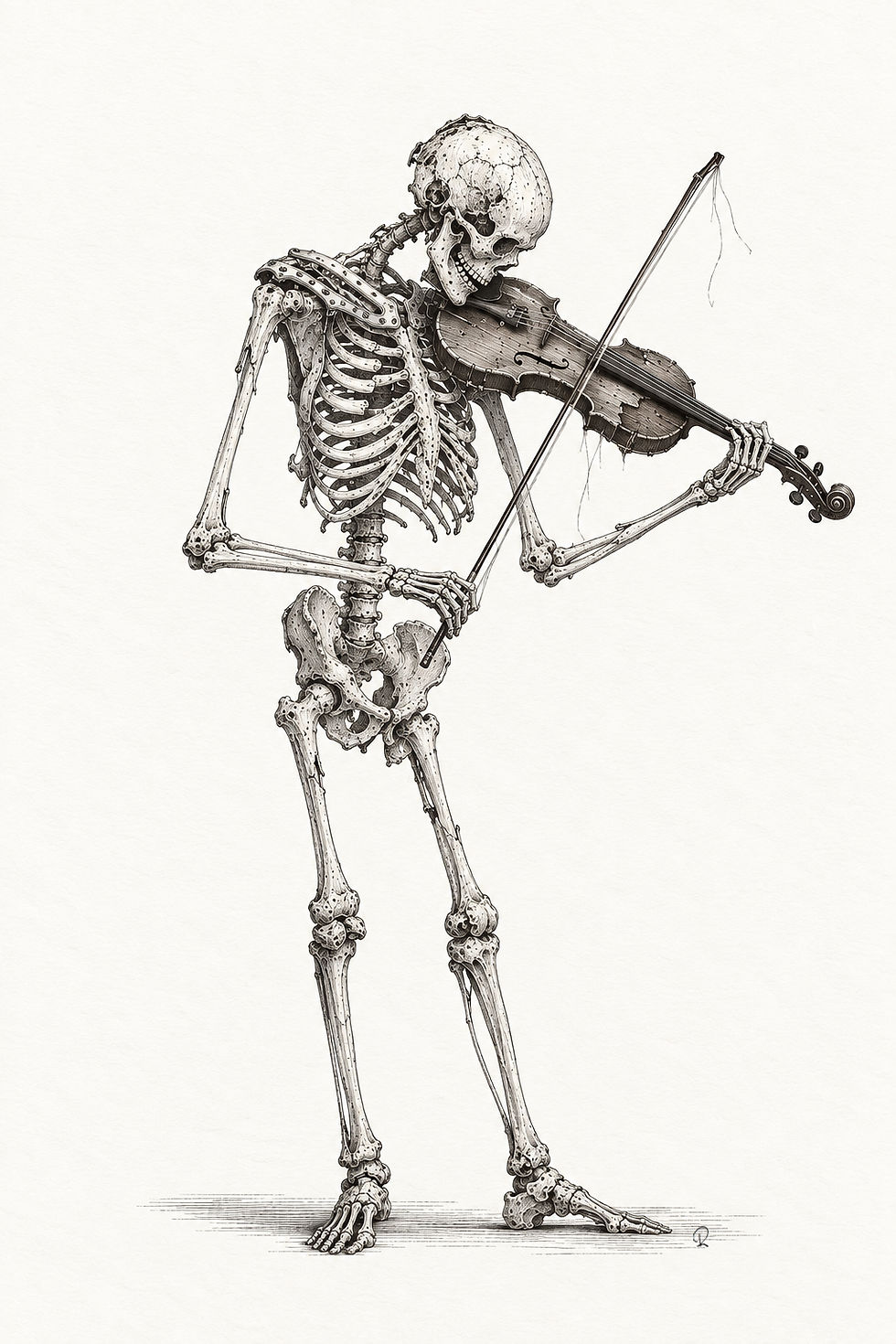
There is a famous moment in American comedy cinema where a man sits earnestly on a staircase, playing an acoustic guitar to an appreciative crowd. Another man walks down the stairs, grabs the instrument, and smashes it into absolute ruins against the wall. He smiles, and walks away.
For decades, popular American culture has celebrated the smasher. He holds the power. He dictates the room. He is the ultimate, disruptive "winner." For the more refined taste, it's just the opposite, quietly well aware that their opinion was often seen as faint of heart.
You don't have to be a poet to strip away the laugh track and conclude the image is profoundly heartbreaking. For anyone who has ever loved music, for parents watching their children learn an instrument, or for musicians who know the soul poured into a wooden frame, that scene is an act of casual cruelty.
Yet, millions have been conditioned to cheer for the smasher. This dynamic exposes a critical pillar of modern Americanism: a mindset globally perceived as a relentless, aggressive strive for the absurd idea of being the perfect, superb winner who crushes all "losers" on the planet. From the gladiator pits of the UFC to hyper-staged, reality-TV politics, global audiences increasingly look at the United States through this specific lens—a culture in love with a childish, skull-crashing, consequence-free illusion of total dominance.
But this black-and-white worldview is a magnificent deception. In reality, the pure win does not exist. It is a concept found only in comic books and cartoons, where a hero falls from a fifty-story building, lands on his feet, limps for two drawings, and is instantly whole again. Real life is never like that. In the real world, the truth is always found in the nuanced middle. Every conflict, every corporate battle, and every war forces both parties to share in both the loss and the win. The man who beats his opponent into a pulp walks away with broken bones in his own fist, a bruised soul, and a quiet lifetime of blame.
The Social Media Trauma: The Zero-Sum Trap
This obsession with the staged illusion of winning has mutated into the defining trauma of our modern era. Today, the colosseum isn’t just an arena or a political stage; it is digital, permanent, and tucked inside the pockets of everyone—forced to online presence under penalty being perceived as non-existent.
We have created an online trash jam of plastic prestige. Youngsters are carrying profound psychological trauma, poisoned by a deep sense of shame simply because they do not possess the "perfect" bike, the "perfect" house, or the lifestyle curated by algorithmic lies. We watch people dress their bodies up in AI-generated imagery, rolling their muscles and flexing synthetic achievements to prove they are winning a game that isn't even real.
The mathematical math of this game is often detached from reality. We are living with billions of people on a crowded planet. If the game of life demands that billions of human beings must be "losers" just so one person can stand on a pedestal as a "winner" for a single fleeting second, society collapses under its own weight. Even if we played a game where everyone got to be a winner for just one moment, it would take centuries for everyone to get a turn. By the time the last person finally tasted victory, the earlier winners would grow so frustrated by the wait that they would form a gang, start a dictatorship, or drop a bomb on the new winners just to take the crown back.
Numbers and metrics have become completely irrelevant. Everything has become abstract, reduced to a hollow currency of digital tokens, badges, and likes. Even Elon Musk, a trillionaire, had to crawl through a psychological and corporate hell to dig up 40 billion dollars in cash for a platform purchase he promised on a whim, nearly breaking under the reality of his own abstract game. When winning is detached from human scale, it ceases to be an achievement. It becomes a sickness.
The Deep Psychology of the "Winner" Trap: Why the Trophy is a Cage
The supreme irony of this hyper-commercialized culture is that its champions are actually its ultimate prisoners. Psychologically, measuring worth entirely by external victory forces a person onto an infinite treadmill of anxiety. Because this brand of greatness exists entirely outside the self—in a bank account, a poll number, or a crowd’s roar—it requires perpetual, exhausting defense. There is always another rival to crush and another critic to silence.
Consider the American presidency. Winning an election offers perhaps five minutes or five hours of pure ego-validation. Immediately after, it demands years of immense burden, fierce criticism, and an impossible job that no single human being can perform to the applause of hundreds of millions of people. Some leaders navigate this reality with grace. They allow the office to age them visibly, carrying the gray hairs, the lines of exhaustion, and the "wounds of blame" as a badge of honest, human compromise.
But a leader trapped in the brand of perpetual winning cannot afford this vulnerability. Because their followers demand an untouchable idol, the leader must actively kill their own empathy. To maintain the illusion of the "total win," they must fabricate a delusion where they are perfectly loved and entirely flawless. They can never rest, reflect, or experience true peace, because a single admission of struggle breaks the macho spell.
The same rot poisons the illusion by oversimplifying and thus killing the capitalist American Dream within itself. —The American Dream was an open pathway to possibilities, which is by its nature never without setbacks and lessons to learn. Entrepreneurial success is never a perfectly curved chart of growth (maybe from afar with a lot of fog). Wealth, promised as ultimate victory, is far from heavenly sublimity. The top of that mountain is, for starters, entirely isolated. The moment you achieve hyper-success, a genuine human connection dies. Every relationship is poisoned by suspicion: Do they love me, or do they love my proximity to my wealth? And before you dream about Lamborghinis—in most cases, wealth without effort ends in the gutter. "Money needs a boss". There's a sense of frugality and profound human respect in true wealth. Many wealthy donors confessed to paying their conscience for a break on whispers of inequality.

Whistler's Mother is engraved, if not literally enshrined, in our American cultural DNA. Yet her quiet lesson—to search for the blessing concealed within disappointment—often seems forgotten.
The Lonely Win
By demanding absolute loyalty and subservience, the "winner" drives away honest friends and surrounds himself with sycophants. He loses the very thing comedian Jim Carrey once highlighted when he joked that behind every great man is a woman rolling her eyes. He loses the grounding force of someone who loves him enough to mock his inflated ego and anchor him to the soil of reality.
The Revolutionary Deception: The Divided Birth of a Nation
To justify this aggressive, "One Flag, One Fury" mentality, mainstream commercialism has rewritten history into a pristine, heroic march of singular glory. But real history laughs at this comic-book narrative. This essay is written with an American heart, from deep within the American culture, and it is precisely for that reason that we must look at our roots honestly.
As the remarkable historian Carol Berkin has brilliantly demonstrated to her students, the American Revolution was never a unified, idealistic crusade to beat the hell out of the British. In rural areas and regions far removed from the elite power centers of Boston and New York, everyday people were fine with British rule. They were thriving, trading, and living quiet, balanced lives. In many cases, they often switched the flag on the pole, depending on which troops were near.
Furthermore, these rural populations recognized a profound political truth that modern audiences have forgotten: If we don't pay taxes to a King across the ocean, we will just end up paying taxes to the ambitious, local federalists who want to swallow our individual states into one giant, centralized empire. They didn't see the founding fathers as flawless demigods; they saw them as another group of powerful men seeking dominance.
The birth of America was messy, fractured, and deeply localized. The myth of the monolithic, conquering American hero is a modern corporate invention designed to sell a product—and a political ideology—built on social Darwinism. The real American Dream was never about crushing an opponent; it was about the freedom to exist outside the empire’s gaze.
The Paradox of True Greatness: Strength in the Smallest Places
This brings us to a revolutionary paradox found at the heart of secular ethics and the ancient teachings of figures like Jesus Christ. Absolute greatness is never found in the tallest, the richest, the strongest, or the most heavily armed. It is found in the smallest, most humble among us.
When greatness is measured by external validation—by titles, trophies, and crushed opponents—the soul binds itself to a fragile, unyielding anxiety. True strength is the exact opposite: it is internal freedom. When a person anchors their worth in inner peace, empathy, and clemency, the external Colosseum loses all its power. If the crowd boos, or if material wealth vanishes, their core identity remains completely untouched.
The humble person is the ultimate threat to a tyrant because they cannot be bought, intimidated, or manipulated by titles they never cared to possess. Empathy is inherently generative; it builds communities, mends broken ties, and heals trauma. Dominance is inherently destructive; it leaves nothing behind but ruins, bitterness, and hidden animosity.
The Automatic Jester: Counterculture as Our Brain's Sanity
Because the limitless love a human being cultivates for their own ego is a dangerous, blinding sickness, humanity has always developed a built-in defense mechanism. That defense is counterculture. True counterculture is much broader and more elusive than a commercial genre or a retail category; by definition, it acts as the automatic jester of our civilization.
It is an intellectual ecosystem rooted in satire.
Satire is not merely entertainment; it is an essential part of being human and a fundamental requirement for the sanity of our brains. Humans are unique specimens: we are the only creatures on Earth who possess the capacity to laugh at ourselves, deliver self-criticism, and consciously examine our own destructive tendencies.
This satirical impulse operates as a cultural immune system. Even in the grim, heartless realities of war, artists have always emerged on the front lines or in the margins of daily newspapers to draw satirical cartoons, piercing the propaganda of absolute victory with the sharp needle of truth.
Historically, this psychological safety valve was institutionalized at the very center of power. During the crudely brutal medieval period, absolute kings formally hired court jesters. These fools were far from simple, unthinking clowns—they were trusted partners, artists, and poets. They were the only individuals legally assigned and entitled to doubt the king's thoughts. The medieval court recognized that without an institutional voice to deliver delicate, witty self-criticism, a ruler would inevitably lose their mind to their own vanity.
The presence of jester-like characters and functions was interwoven in the circles of power that ruled ancient Egypt, as also in ancient China. Power often suffers from wounds invisible to the eye: isolation, vanity, and the gradual loss of honest feedback. The fool served as both mirror and medicine, helping rulers heal from the dangerous illusion that they could no longer be wrong.
Today, we have completely banished the jester from the halls of power, replacing them with digital echo chambers and plastic praise. The joker, the jester, the self-critisism is often the absent counterweight, because the modern "superb winner" brand is too fragile to survive the liberating sanity of a joke.
Dolly Parton’s Shakespearean Subversion and Hidden Subversion
Yet, despite the corporate effort to silence doubt, the automatic jester continues to thrive subcutaneously across a massive web of cultural fields. Sometimes, it lives on its own isolated islands, completely ignoring the mainstream camera standpoint.
This was the genius of Frank Zappa, an artist who defied rock-and-roll categorization because he used his complex avant-garde arrangements to aggressively lampoon the plastic consumerism of suburbanism. It lives in the irreverent country-satire of Kinky Friedman—Willie Nelson’s close brother-in-arms—who proudly used the cowboy archetype to expose political hypocrisy and bigotry. It shaped generations through the pages of MAD Magazine, which transformed the pristine, post-war American suburbs into a hilarious parody, teaching children to look critically at the corporate machines running their lives.
Most profoundly, this jester spirit is embodied in the genius of Dolly Parton, who crafted an exquisite, almost Shakespearean parody of herself. In the plays of Shakespeare, the fool is frequently the wisest character in the room—the only one allowed to speak truth to the crown because the court underestimates them.
Dolly adopted this exact role. By dressing up as an exaggerated, rhinestone-covered, hyper-feminine caricature of traditional rural Americana, she became completely untouchable by the conservative, patriarchal establishment.
They laughed at the look, completely missing the razor-sharp intellect underneath. Behind that dazzling outfit lay a true-heart manifesto of female emancipation, gender equalization, and working-class independence (Literally—from 9 to 5).
She didn't achieve freedom by beating men into a pulp in a boardroom; she achieved it by touching audiences through performance art. She won the game by refusing to play by their rules—you bet she did.
The Triumph of the Eye-Roll — Some Biblical Truth Revealed By the Fool
Life is not a television animation where the giant knocks his opponent unconscious and walks away into the sunset without a scratch. Every war leaves the victor bleeding; every structural conquest isolates the conqueror. We all, in whatever we do, have to process our wounds physically and mentally. Consequence-free win is a Hollywood myth. The true winner is the Victor inside of us, striving to become the better version of ourselves.
And standing right beside us is the one who truly cares, quietly rolling their eyes when the pompous little pilot in our heads starts revving the engine for yet another unnecessary flight.


Comments