
Aviation. Is This the End of an Affair?

Article by Rik Raats
THE END OF AN AFFAIR — Or an Everlasting Passion? — How Romance, Sacrifice, Obsession, and the Ancient Dream of Flight Still Circle Each Other at 35,000 Feet
It All Begins with Longing
Long before boarding passes and departure gates, before aircraft stitched continents into navigable patterns, there was something simpler—and far older.
Longing.
Not merely the longing of lovers, though aviation has produced its share of whispered affairs and fleeting romances, but the deeper human longing born from watching birds cross the sky—effortless, unbound, untethered to the earth below.
For centuries, humanity looked upward and wondered what it might feel like to follow.
To rise above distance, to escape geography move freely, as wings were meant to move.
Aviation did not create that longing. It fulfilled it.
And in fulfilling it, something unexpected happened: humanity did not simply invent flight—it fell in love with it.
This love affair was never purely mechanical. It was emotional from the beginning. The first flyers were not just engineers—they were dreamers, romantics in leather helmets, men and women willing to gamble safety for the chance to leave the ground.
Flight answered something ancient inside us: the desire to be unbound.
And once humanity tasted the sky, there was no returning to earth in quite the same way.
When the Sky Was Young and Glamour Was the Cargo
Yes—there was a time when flying felt like theatre.
Passengers arrived dressed with intention. Not hurried, not distracted, but aware that they were stepping into something rare. Airports were smaller then, quieter—almost ceremonial spaces where departure itself felt like achievement.
Inside the cabin, the experience carried rhythm and grace. Meals arrived on polished trays. Conversations lingered. Windows framed unfamiliar coastlines like paintings in motion.
Flight was not routine. It was occasion.
For those who worked in aviation, the sky became frontier. Pilots and flight attendants traveled together not only across oceans but across cultures. Layovers were longer. Cities became temporary homes. Evenings stretched into discovery rather than recovery.
And in that world, romance felt natural. Not inevitable—but understandable.
Shared journeys create intimacy. Distance from ordinary life breeds connection. In the golden decades of aviation, relationships formed between people who navigated unfamiliar landscapes side by side, who shared meals in distant capitals and watched unfamiliar sunrises through unfamiliar hotel windows.
Even culture absorbed the myth.
The stage comedy Boeing-Boeing, first written in 1960, turned airline schedules into romantic farce. In its world, flight timetables were not instruments of logistics but tools of deception—allowing lovers to arrive and depart like carefully timed aircraft.
The play exaggerated reality. But not entirely.
Because behind the laughter was a recognizable truth: In aviation, time and proximity shape relationships in ways few other professions experience.
Passengers Lost the Romance—Crew Never Had the Luxury
For passengers, the love affair with flying began to change when economic pressure tightened its grip on the aviation industry. Keeping aircraft fueled was one challenge; making a profit became the larger drama, one that gradually stripped the flying experience to the bone.
What had once been privilege became necessity. And necessity—driven by competition and relentless cost efficiency—pushed the industry toward bare standards, where few superfluous luxuries survived. Drinks once included in the fare quietly disappeared. Seats narrowed. Passengers were packed tighter, almost like cargo, while even luggage became an optional extra, priced separately.
Airports expanded into vast systems designed not for wonder, but for efficiency. Check-ins turned into human-robotics procedures. Boarding procedures tightened. Cabin space shrank—inch by inch, row by row. AI-driven customer support leaving elderly in cold-sweat nightmares.
The thrill faded not because flying became less miraculous—but because it became part of the hurdles and hoops inevitably part of staying afloat in this world.
Passengers board aircrafts, but fewer do so with wonder. For crews, however, romance had always been conditional.
Flight attendants and pilots never experienced aviation as leisure. The aircraft was workplace—demanding vigilance, discipline, and emotional control. While passengers slept, crews monitored systems, managed behavior, calculated contingencies.
Modern aviation added pressure to that responsibility.
Understaffed schedules strain endurance. Passenger frustration—born of discomfort, delay, and fatigue—often spills into the cabin. Smiles are maintained not out of glamour but professionalism. Calm becomes performance. Patience becomes survival.
Layovers once meant exploration.
Today, they often mean recovery. Curtains drawn. Phones silenced. Sleep prioritized over scenery.
Romance does not vanish under these conditions—but it competes with exhaustion.
And exhaustion usually wins.
Love at Altitude: The Sociology of Cabin Romance
Yet despite fatigue and structure, relationships persist. Not by accident—but by proximity.
Research across the transport and logistics sector reveals what insiders have long understood intuitively: workplace relationships occur here more frequently than in many other professions. Surveys suggest that as many as 84 percent of individuals in the sector report having experienced workplace relationships, significantly higher than many other industries.
Shared experience builds understanding.
Only another crew member truly understands the strange rhythm of aviation life—the night flights, the missed celebrations, the sudden loneliness of unfamiliar cities. That shared understanding becomes emotional shorthand.
And from shorthand, intimacy sometimes grows.
Relationships between aviation professionals also tend to persist longer than expected. Studies suggest that roughly two-thirds of workplace relationships in the sector last longer than six months, a notable statistic in professions defined by mobility and instability.
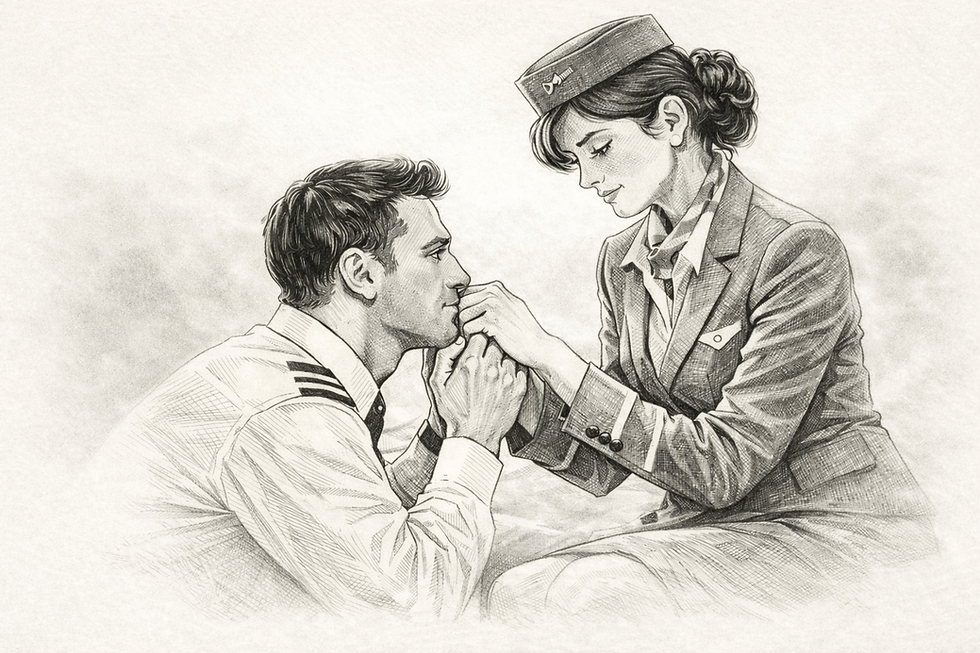
Demographics reflect similar patterns. In modern airline environments, a large percentage of cabin crew members remain single during active flying years—some surveys placing that figure above 60 percent, with even higher rates in certain regions.
Romance, in aviation, is rarely casual coincidence. It is structural.
It emerges from lifestyle rather than opportunity. And while Hollywood dramatizes these connections, reality is less glamorous—but more enduring.
Born with a Boeing in His Mind
Not all love affairs in aviation occur between people. Some unfold between individuals and machines.
There exists a specific breed of dreamer—the aviator entrepreneur—often someone who fell in love with aircraft long before understanding their cost.
Many began as children pressing their faces against airport fences, memorizing airline liveries and flight numbers, imagining futures defined by runway lights and engine noise.
Some grew into legends.
Tony Fernandes purchased a failing airline for the symbolic price of a single coin, mortgaging his own future to rescue a company buried in debt. Against expectation—and timing that coincided with global aviation crisis—he transformed that gamble into one of the world’s most recognizable low-cost carriers.
Freddie Laker, years earlier, pioneered affordable long-haul travel, challenging powerful national airlines with a vision that democratized flight. His airline ultimately collapsed, but his ideas reshaped the industry.
Juan Trippe once convinced manufacturers to build aircraft that did not yet exist, betting the future of his airline on the success of a revolutionary wide-body jet. His gamble altered aviation history.
And then there was Richard Branson, perhaps the most theatrical embodiment of the aviator entrepreneur. Where others relied on quiet calculation, he understood spectacle. He turned personality into marketing fuel, daring to challenge established national carriers with the creation of Virgin Atlantic, proving that audacity could become strategy. His success helped redefine aviation not only as transport, but as brand experience—an industry where personality itself could become part of the aircraft’s livery.
But aviation dreams do not always land safely.
Few modern stories capture the fragile balance between ambition and survival better than the rise and fall of WOW air. Founded with bold optimism and unmistakable branding, the airline promised affordable connections between continents through Iceland’s geographic advantage. For a time, the vision worked. Aircraft filled. Routes expanded. Purple aircraft tails became symbols of accessible adventure.
Yet growth in aviation is rarely forgiving.
Fuel costs surged. Debt mounted. Competition tightened its grip. Expansion that once symbolized ambition became burden. In 2019, WOW air collapsed almost overnight, grounding aircraft and stranding passengers across continents. Thousands lost jobs. Travelers were left searching for alternatives in distant terminals. What had begun as visionary optimism ended as abrupt silence on the runway.
It was not merely a corporate failure. It was the reminder of aviation’s oldest truth: in the sky, passion builds momentum—but gravity always waits.
Aviation is not just an industry. It is a love affair that even the most rational minds cannot entirely avoid.
Even the most disciplined financial minds have struggled to resist aviation’s pull.
For decades, Warren Buffett warned investors to stay clear of airlines, famously suggesting that aviation had destroyed more capital than it created. Yet even he eventually reconsidered, investing billions into major carriers once industry consolidation appeared to promise stability and rational pricing.
For a brief moment, it seemed that logic had finally tamed aviation’s volatile nature—until global disruption forced him to withdraw once again. His evolution, from skepticism to cautious belief and back to restraint, reflects aviation’s enduring paradox: aviation is not just an industry. It is a love affair that even the most rational minds cannot entirely avoid.
Love, Obsession, and the Price of Lift
Not all tragedies in aviation unfold in the air. Many unfold in private lives.
The pursuit of flight demands sacrifice few outside the profession fully comprehend. Training alone consumes years and resources. Estimates suggest that between 70 and 80 percent of aspiring pilots abandon their journey before completion, undone by cost, difficulty, or sheer exhaustion.
Even among those who persist, only a fraction achieve full qualification.
Dreams begin easily. They finish expensively.
The pattern resembles other high-risk vocations driven by admiration and spectacle. In Spain, for example, only five or six out of every hundred aspiring matadors ever reach professional status.
The rest retreat quietly. Aviation mirrors this reality.
Many begin. Few endure. Fewer succeed. And sometimes, the price is not financial but personal.
Marriages strain under absence. Families fracture under uncertainty. Passion for flight becomes silent rival within households—demanding attention, loyalty, and sacrifice.
History records darker consequences as well: jealousy, rivalry, emotional collapse. Lives reshaped by devotion to professions that leave little room for compromise.
Aviation, like love, magnifies emotion. And occasionally, heartbreak.
Love Affairs Rarely End—They Change Altitude
Despite hardship, few who enter aviation leave it entirely. Even after careers end, the relationship persists.
Former crew members migrate into travel agencies, hospitality, tourism boards—fields where movement remains central. Airlines increasingly recognize this phenomenon, transforming experienced personnel into ambassadors of travel itself.
The attachment becomes identity. Not profession. Identity.
Surveys reflect aviation’s continued cultural prestige. Even today, a majority of adults view pilot careers as among the most desirable professional paths, reflecting enduring admiration for the role.
Interest remains strong among future cabin crew as well, with global projections estimating the need for hundreds of thousands of new aviation professionals over the coming decade.
In an era of rising costs, heightened security, and compressed comfort, the fascination survives.
Not unchanged—but intact.
Because beneath every ticket purchase and every departure announcement lies something older than industry itself.
The desire to move. To explore. To rise.
And perhaps that is why the love affair between humanity and flight has never truly ended. It has matured. Weathered disappointment. Absorbed sacrifice. Survived routine.
But still—each morning—aircraft gather speed along concrete runways, engines building toward lift, wings cutting into open sky.
And somewhere, in that moment when wheels leave ground and gravity loosens its hold, humanity repeats the same ancient gesture: Looking upward. Still believing. Still longing. Still flying.


Comments