
Fisherman Who Failed Gets the World to Win


By Rik Raats
The Marlin of Literature — born from the waters of Ernest Hemingway's borderless mind — illuminates future pathways in today’s struggle between pride and provision in a rapidly transforming global economy and workplace.
Fisherman at Dawn—the Believer Amidst Uncertainties
Before the sun rises, the sea already knows who belongs to it. The harbor still sleeps when the fisherman steps onto the wooden planks of the dock, feeling the slight movement beneath his feet as the tide breathes against the pilings. The air smells of salt, wet rope, and the lingering memory of yesterday’s catch.
Somewhere in the darkness a gull complains, as though reminding the harbor that the day’s labor is about to begin.
This hour belongs to fishermen. It always has.
Across centuries and continents, men have launched small boats into uncertain waters with the same quiet understanding: today the sea may provide, or it may refuse. Families wait on shore for what returns in the nets. A household’s stability depends on the fragile conversation between human persistence and the generosity of nature.
It is this ancient drama that Ernest Hemingway captured when he wrote The Old Man and the Sea. On its surface, the story appears simple enough to be told in a few sentences. An aging Cuban fisherman named Santiago sails into the Gulf Stream after an exhausting eighty‑four days without catching a fish.
He leaves the shores of common sense farther behind. Far out—where the logic of men ends and the deep abyss begins—he stakes his life on his own endurance.
He turns the tables on despair, as he hooks a marlin of astonishing size and spends days locked in struggle with it before finally bringing the creature alongside his small skiff.
—Yet the story does not end where the odds of fortune reverse course.
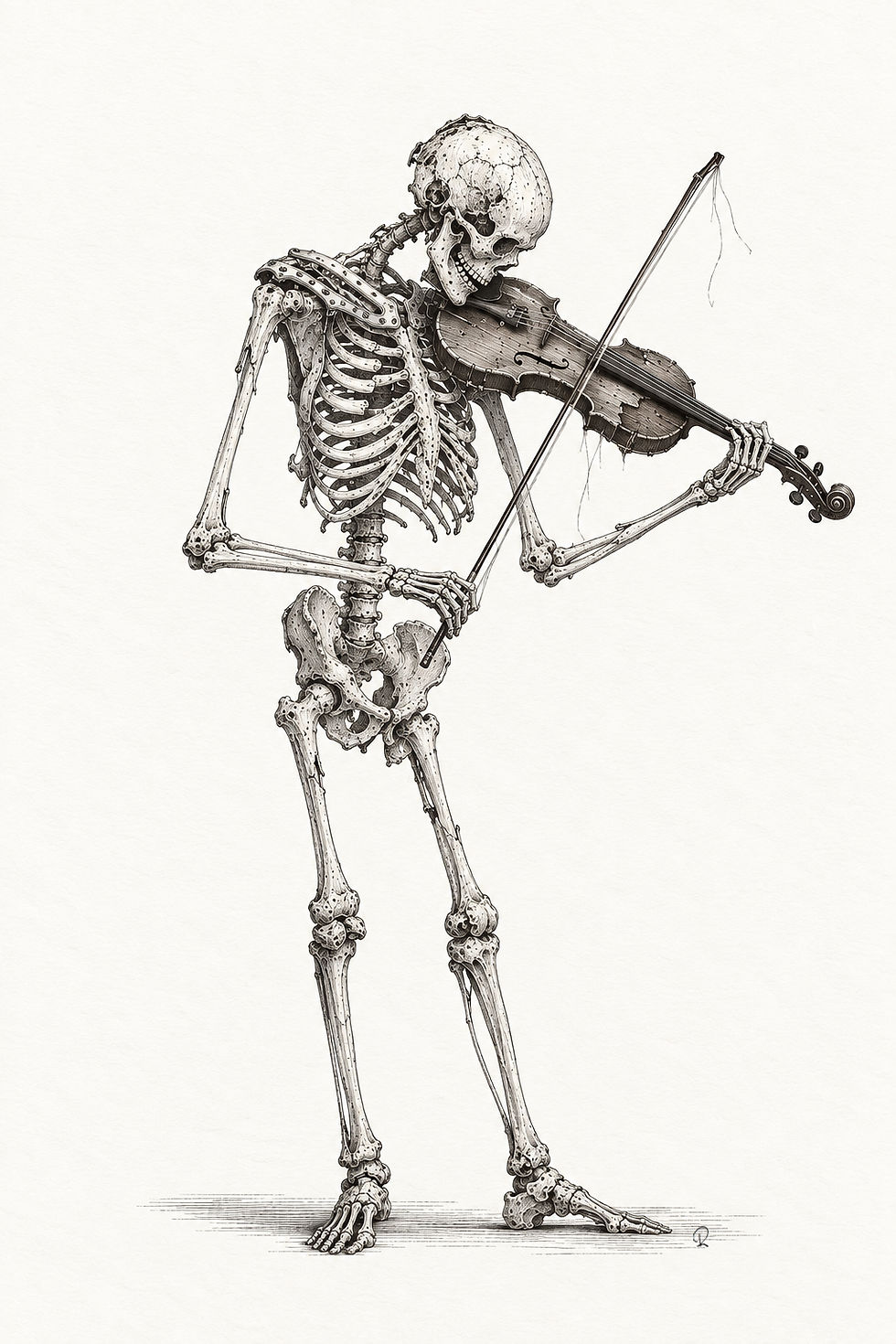
The victory dissolves on the journey home. Sharks tear into the marlin, leaving nothing but a skeleton when Santiago reaches the harbor. By the strict arithmetic of commerce, the voyage has failed. The village gains no feast. The fisherman gains no profit.
And yet the bones tied to the skiff transform defeat into something else entirely. They testify to a struggle so immense that the village cannot ignore it. The skeleton becomes a monument to effort, endurance, and dignity.
What Hemingway understood—and what human nature explains time and time again both to the choir of believers as to the ratio of non believers—is that societies do not live on bread alone. They also live on stories.
The Line in the Water
Santiago sails farther from shore than the other fishermen dare to travel. The Gulf Stream stretches around him like an immense blue plain, broken only by the quiet movement of flying fish and the distant arcs of birds that know where life swims beneath the surface.
For eighty‑four days he has caught nothing. In a fishing village, such a number becomes a rumor attached to a man’s name. It drifts across the harbor like smoke. The young fishermen glance at him with polite sympathy. The boy who once fished with him has been instructed by his parents to join a more fortunate boat.
But the old fisherman understands something that statistics cannot measure. The sea does not negotiate with averages. One day of persistence can undo eighty‑four days of emptiness.
When the marlin finally takes the bait, Santiago knows immediately that he has encountered something extraordinary. The fish pulls the skiff forward with quiet authority, as though the ocean itself has taken hold of the line. The rope cuts into the fisherman’s hands, and the boat begins its long passage through open water.
Hours become a day. A day becomes another.
The struggle between fisherman and fish turns into something larger than survival. It becomes a conversation between two living beings testing each other’s endurance. Santiago speaks aloud to the marlin, calling it brother and rival in the same breath.
“I love you and respect you very much,” he says quietly.
In that moment Hemingway reveals the strange nobility of labor. The fisherman must kill the fish in order to live, yet he cannot deny the beauty of the creature he fights. Respect and violence coexist within the same act of survival.
When the marlin finally rises beside the boat, its length dwarfing the skiff itself, Santiago feels both triumph and humility. The fish is magnificent. For a moment he wonders whether any man has the right to conquer such a creature.
Still, he lashes it to the side of the skiff and turns toward home.
The Sharks Arrive
Blood travels quickly through water. Faster than celebration, faster than relief.
The first shark appears beneath the surface as a shadow with purpose. It has not witnessed the long duel between fisherman and marlin. It knows nothing of patience, exhaustion, or dignity. It knows only that a wounded creature drifts nearby.
The attack is swift. Santiago kills the shark with his harpoon, but the sea has already received its message. The scent spreads outward like a signal flare.
More sharks arrive
They tear into the marlin with relentless efficiency, stripping away the flesh that had seemed so triumphantly secure only hours before. The fisherman fights with whatever tools remain at hand: the harpoon, the oars, the broken haft of a knife tied to a stick.
Yet the sea keeps sending new predators—of course
Hemingway’s sharks represent more than marine instinct. They mirror a pattern visible wherever success becomes visible. Achievement attracts attention, and attention draws those who wish to feed upon it.
Some predators seek a portion of the prize itself. Others desire something subtler—the humiliation of the person who achieved it.
Before a star has fully risen, critics appear. Rumors begin to circulate. Suspicion gathers like clouds around the horizon of reputation.
The fresher the catch, the more likely the pirates
By the time Santiago finally reaches the harbor, the marlin that once seemed so magnificent has been reduced to a skeleton.
Embracing the Story of the Epic Catch While Household Is Starving
From the perspective of a household ledger, the expedition has failed. Bones do not feed families. Courage does not fill a cooking pot. Every community depends on a quiet rhythm of provision. Fishermen must return with fish often enough to sustain the village. Pride alone cannot support a household.
This tension between heroic effort and practical survival has existed in every society. On one side stands the figure who ventures farther than the others—the explorer, the hunter, the fisherman chasing the largest catch. On the other side stands the steady provider whose modest harvests ensure daily stability.
Both roles matter. The heroic story gives meaning to a culture. It reminds younger generations that human beings can achieve extraordinary things.
But the steady provider ensures that the community survives long enough to listen.
The Symbol of Faith—the Magical Power of Victory
And yet the skeleton tied beside Santiago’s skiff carries a power that transcends its economic uselessness. The bones become a symbol—a kind of cross of the fisherman’s faith. History repeatedly shows that material wealth and spiritual legacy rarely travel together. The most enduring symbols of human civilization often emerge from apparent failure.
The story of Jesus Christ offers a striking example. He left behind no estate, no fortune, and no institutional empire. Yet the symbol associated with his suffering shaped the largest communities of the Western world.
Sometimes the story outlives the harvest. Santiago’s skeleton cannot feed the village, but it nourishes imagination. The young boy Manolin sees the bones and understands that the fisherman has faced something immense in the open sea.
The struggle becomes part of the village’s memory.
The devil temped me with a fresh loaf of bread, but I look at the cross and I know, I have a place on the table to dine with the Lord.
The Port and the Prosperous Community: the Story Becomes the Legacy that Harbors a Thriving Economy
Still, no harbor survives on symbols alone. A thriving maritime society requires both story and the structure that enables fast-forward development.
The fisherman provides the myth that defines the identity of the sea. But merchants, shipbuilders, insurers, and traders provide the economic architecture that sustains the port itself.
History’s great ports—from Venice to Amsterdam to Antwerp—thrived because these two forces worked together. Legacies give meaning to harbors. Commerce bring prosperity.
Remove the story and the harbor becomes a warehouse. Remove the economy and the story fades into nostalgia.
The Bloody Danger of Blind Fidelity to a Craft—Never Go Back In Time.
Yet loyalty to a craft can become dangerous when it refuses to evolve. In Alphonse Daudet’s tale Le Secret de Maître Cornille, an old miller insists on operating his traditional windmill long after modern steam mills have replaced it. His devotion is admirable, but it becomes tragic.
Put History on the Flag of Credibility While Marching Fast Forward.
Every profession survives only by adapting to changing conditions. Technology shifts. Markets transform. Cultural habits evolve. The craft that refuses to move with the world eventually becomes a museum piece.
Sometimes honoring a father’s profession requires reshaping it for a different century.
The Accordionist's Tragedy — a Life Lesson
Europe once echoed with the sound of accordion music spilling from cafés and taverns. The instrument animated evenings of dance, conversation, and local celebration.
"He was such a great accordionist." (Then the jukebox arrived.)
Mechanical music replaced live performers across the continent. Thousands of accordion players suddenly found themselves displaced by a machine that could play endlessly without payment. Yet the accordion did not disappear.
Musicians adapted. They carried their instrument into orchestras, recording studios, and classrooms. Many became teachers who shaped the music of the next generation. The cafés changed, but the music survived.
The New Pride and Providence
Today another transformation unfolds. Artificial intelligence and digital platforms reshape industries with astonishing speed. Millions of individuals navigate economic uncertainty as independent contractors, freelancers, drivers, or creators.
The modern economy resembles an ocean filled with small boats. Each must navigate uncertain currents of technology, competition, and reputation.
In such a world, the ancient tension between pride and provision becomes sharper than ever.
The Marlin of Tomorrow—the Inspiration for Generations to Come
Hemingway’s marlin is more than a fish. It represents the enduring human effort to preserve dignity while confronting uncertainty. The fisherman, the miller, the accordion player, and the digital entrepreneur all face the same question: how does one carry the essence of a craft into a future that constantly rewrites the rules? Santiago returns to harbor with nothing but bones.
Yet those bones prove that the struggle occurred.
The proof of the struggle is exactly what inspires the next voyage.


Comments