
The Longing That Europeans and Americans Have in Common
Updated: Jun 29
Article by Rik Raats
— It is often said that Europeans have roots and Americans have wheels.
There is some truth in that observation. Many Europeans still grow up in the same town where their parents lived, buy or build a home nearby, and remain connected to the same network of family, friends, cafés, churches, clubs, and traditions for decades. Americans, by contrast, have long been associated with mobility. New jobs, new opportunities, new states, and sometimes entirely new lives are considered part of the journey.
Yet after spending years on both sides of the Atlantic, I have come to believe that Europeans, Californians, and many other Americans have far more in common than either side often realizes. —The common denominator is not geography. It is longing. Not necessarily longing for a country, but longing for a chapter of life.
I was reminded of this while reading excerpts from a letter written by Adèle Bloemendaal from Hollywood in the 1950s. At twenty-one, she had moved to California with her husband, who had found work with Lockheed. She was enjoying concerts, reading literature, discovering America, and living in the very place that many Europeans dreamed about.
A Record Arrived
Then a record arrived from the Netherlands.
It was a Johnny Jordaan record.
She placed it on the turntable, fully expecting to listen with amused superiority to a piece of Amsterdam folklore. Yet before the first song had finished, she found herself in tears.
Suddenly, she was no longer in Hollywood—she was back in the Jordaan. Back among the streets, people, and memories that had helped shape her.
The Same Longing, Different Landscapes
I have seen the same reaction among Californians whose families moved repeatedly throughout their childhoods. Many grew up in several towns before adulthood. Some lived in California, Arizona, Texas, Oregon or beyond. They learned to adapt, reinvent themselves and move forward. They became experts at starting over.
Yet decades later, an old country song, a photograph of a vanished orange grove, a high school football field, an AM radio station, a county fair or the sight of a roadside diner can suddenly transport them back in time.
The emotional mechanism is identical. A Belgian remembers a village square.
An Amsterdammer remembers the Bloemgracht. A Californian remembers a ranch, a subdivision, a baseball diamond or a county fair.
Stricken in the Moment—As We All Are Missing a Version of Ourselves.
What they are really missing is not the place itself. They are missing a version of themselves. The place merely serves as the key that unlocks the door. I recognize this phenomenon in myself.
In 2024, in Santa Monica, I recorded Lichtjes van de Schelde, a song closely associated with Bobbejaan Schoepen. I had often performed Flemish songs for American audiences who did not understand the language, yet somehow understood the sentiment.
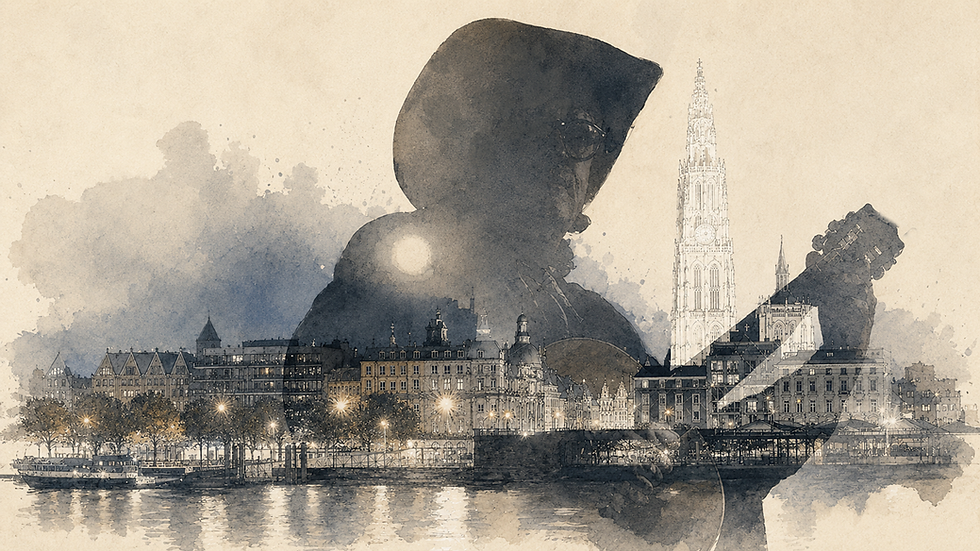
For that recording, images of Antwerp accompanied the music video: the Cathedral of Our Lady, the illuminated skyline, the river and the city that had shaped so much of my own life.
The recording eventually reached Bobbejaan's family in Europe. Their reaction was warm and heartfelt, as were many of the public comments that followed. Yet what stayed with me most was something I had not anticipated myself.
Making that recording did not merely express my connection with Antwerp. It strengthened it. The city was no longer something that appeared only in dreams, memories, or moments of nostalgia. By sharing those songs with an American audience, I was bringing my roots closer to myself. Somehow, it made me feel more whole.
Over the years I noticed that many Americans did exactly the same thing.
Friends from Kentucky carried Kentucky with them in their stories, their humour, their accents and their music. Texans often seemed to embody the old saying that you can take someone out of Texas, but you cannot take Texas out of them. The details differed. The mechanism did not.
Perhaps this is why conversations between Europeans and Americans can sometimes feel surprisingly familiar. Beneath the differences in culture, politics and history lies a shared human experience.
We all carry invisible maps.
We all have songs that function as time machines. We all remember people who are gone, places that have changed and seasons of life that can never fully return.
A Dutch cabaret song, a Flemish chanson, a California country ballad or a scratchy cassette recording may seem insignificant to an outsider. Yet to the listener, it contains entire worlds.
That is why a song can make a grown man cry.
Not just because of the melody. Not just because of the lyrics. But because, for a few brief moments, it allows him to visit a chapter of his life that still lives somewhere inside him.
As many Americans descend from families that once came from somewhere else, and as many Europeans have found parts of their lives on other shores, perhaps we have more in common than we sometimes think.
Whether one generation removed or many generations removed, we remain, in a sense, pilgrims.
Working, dreaming, creating, reasoning and building.
Carrying with us not only our ambitions, but also the places, voices, songs and stories that helped make us who we are. In that sense, Europeans, Californians and many other Americans are not so different after all.
We are all, from time to time, homesick for ourselves. It's part of being pilgrims, whether we choose to be one or not.
Source note: The reflections on Adèle Bloemendaal's Hollywood letters were inspired by excerpts shared by Jacques Klöters from her correspondence with family in the Netherlands.


Comments